








Tanzania is home to one of the most remarkable wildlife events on Earth: the Great Wildebeest Migration. Every year, millions of wildebeest, together with large numbers of zebras and gazelles, move through the Serengeti ecosystem in search of fresh grass and water.
This incredible natural journey is one of the main reasons travelers from around the world choose Tanzania for a safari. The migration offers spectacular wildlife encounters, dramatic landscapes, and unforgettable opportunities to witness nature in its rawest form.
With Gleam Horizon Safari, you can experience Tanzania’s wildlife migration with a professional local safari team based in Arusha.
The Great Wildebeest Migration is the continuous movement of huge herds of wildebeest across the Serengeti in Tanzania and the Masai Mara in Kenya.
The animals follow seasonal rainfall and the availability of fresh grazing. Their movement is not a single event with fixed dates. Instead, it is a year-round cycle that changes according to weather and environmental conditions.
Along the journey, the herds face natural challenges, including predators, changing weather, rivers, and long distances across the plains.
Most of the migration takes place within the Serengeti ecosystem in northern Tanzania before the herds move toward Kenya’s Masai Mara.
The Serengeti provides vast grasslands and seasonal water sources that support the enormous herds. Different areas of the park offer different migration experiences throughout the year.
For this reason, choosing the right safari location is important when planning a migration-focused Tanzania safari.
The migration cycle begins with one of its most spectacular stages: the calving season.
During the early months of the year, large herds gather in the southern Serengeti and surrounding areas where fresh grass provides important nutrition for pregnant wildebeest.
Thousands of calves are born during this period. The abundance of young animals also attracts predators such as lions, cheetahs, hyenas, and other carnivores.
For wildlife photographers, this can be an exceptional time to visit Tanzania because predator activity and newborn animals create dramatic and emotional wildlife encounters.
As the grazing conditions change, the herds gradually begin moving north and west through the Serengeti.
The landscape becomes greener during the rainy season, creating beautiful scenery for photography.
Although heavy rainfall can make some areas more challenging to access, this period can offer fewer visitors and a more peaceful safari atmosphere.
The movement of the herds is influenced by rainfall, so their exact location can vary from year to year.
As the dry season begins, the herds continue their journey toward the northern Serengeti.
This is an exciting period because large groups of wildebeest and zebras can be seen moving across open plains.
The western and northern parts of Serengeti can provide excellent opportunities for travelers hoping to experience the migration while also searching for the park’s famous predators.
The northern Serengeti becomes an important migration area during these months.
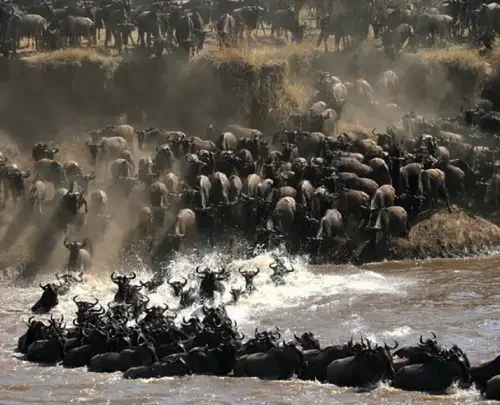
One of the most dramatic parts of the migration is the crossing of rivers, particularly the Mara River. Large numbers of wildebeest may gather at the river before attempting to cross.
However, river crossings are unpredictable. The animals may remain near the river for hours or days before crossing, and there is no guarantee that a crossing will occur during a particular safari.
Watching a river crossing should always be done responsibly and according to park regulations.
As seasonal rains return to the southern Serengeti, the herds begin moving south again.
Fresh grass provides the food they need before the cycle begins again with another calving season.
This completes the continuous migration cycle, although the exact timing and location can change from year to year.
The wildebeest are the main attraction, but the migration supports an entire ecosystem.
During a migration safari, you may also encounter:
The presence of large herbivore herds attracts predators, making the Serengeti particularly exciting for travelers interested in wildlife behavior.
The Tanzania wildlife migration is more than simply watching animals move across the plains.
It is a powerful example of how wildlife depends on seasonal changes in rainfall, food, and water. Millions of animals participate in this natural cycle, creating one of the world’s largest movements of terrestrial mammals.
The scale of the migration is what makes it so extraordinary. Seeing thousands of wildebeest stretching across the horizon is an experience that is difficult to describe until you witness it yourself.
There is no single best month for the entire migration because the herds move throughout the year.
Your ideal travel period depends on what you want to experience.
For calving and newborn animals, January to March is an excellent period.
For the northern migration and possible river crossings, July to October is generally popular.
For greener landscapes and fewer visitors, parts of the rainy seasons can provide a rewarding alternative.
Planning your safari around the seasonal movement of the herds is more important than choosing a fixed migration date.
The ideal length depends on where the herds are expected to be and how much of Tanzania you want to explore.
A short safari can provide a taste of the migration, while a longer safari gives you more time to explore different areas and wait for wildlife activity.
Many travelers combine Serengeti with Ngorongoro Crater, Tarangire National Park, or Lake Manyara to create a more complete Northern Tanzania safari.
The migration is a natural event, and responsible tourism is essential to protecting the animals and their environment.
Visitors should maintain appropriate distances from wildlife, follow their guide’s instructions, respect park regulations, and avoid actions that may disturb animals.
This is particularly important during river crossings, when large groups of vehicles can potentially place unnecessary pressure on wildlife.
Responsible safari practices help protect the Serengeti ecosystem for future generations.
At Gleam Horizon Safari, we help travelers experience Tanzania’s wildlife with carefully planned safari experiences and professional local guides.
Based in Arusha, our team can help you choose the right destination and travel period according to your interests and the seasonal movement of the migration.
Whether you want to experience the calving season, follow the herds through the Serengeti, or combine the migration with Ngorongoro and other Northern Circuit destinations, we can help create a memorable Tanzania safari.
Ready to witness one of nature’s greatest spectacles?
Book your Tanzania Wildlife Migration Safari with Gleam Horizon Safari and experience the incredible movement of wildebeest, zebras, and other wildlife across the Serengeti.